
Biography and Career
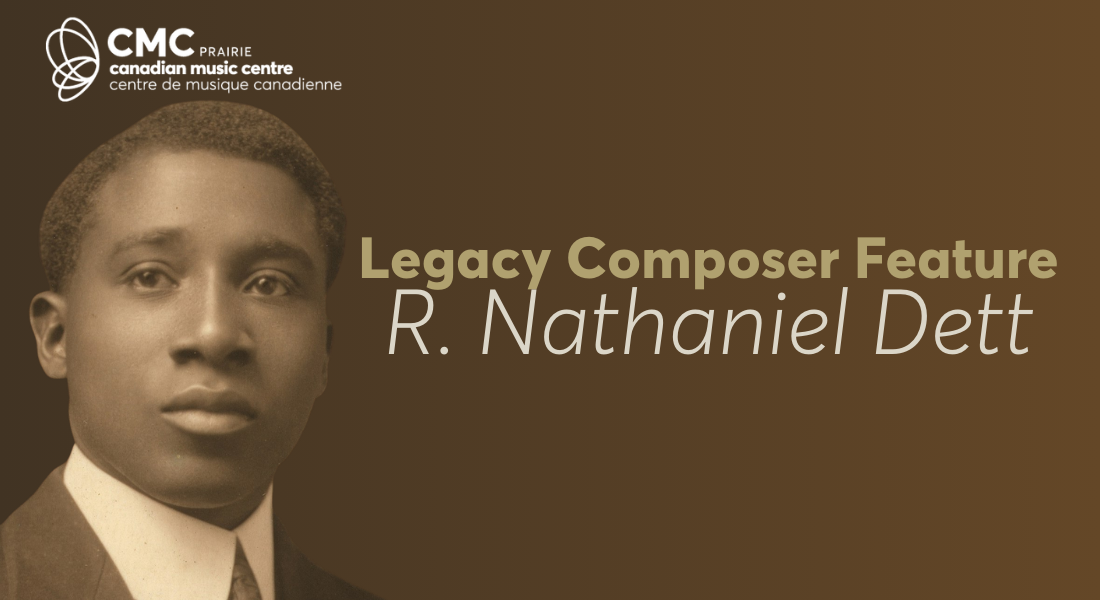
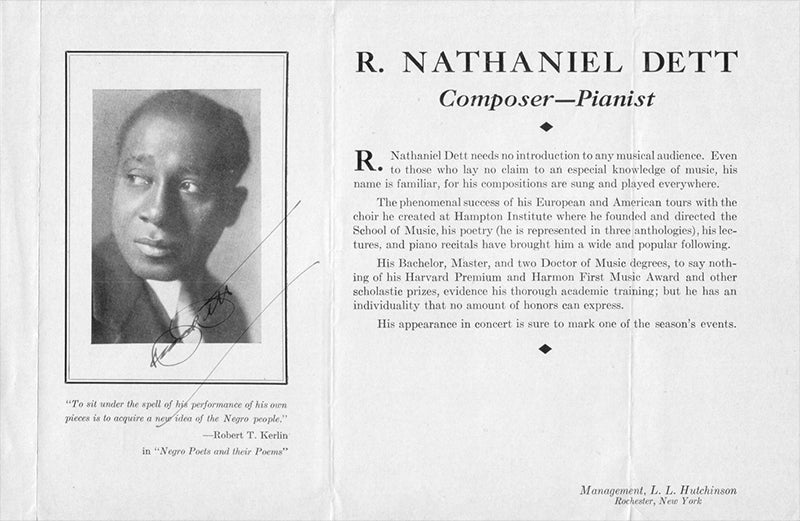
Robert Nathaniel Dett (1882 – 1943) was a Canadian-American Black nationalist composer, educator, conductor, pianist, essayist, and poet who worked to change people’s impressions about Black music during the early twentieth century. As president of the Hampton Institute until his death, Dett was a leading figure of the National Association of Negro Musicians, an organization still active today, dedicated to advancing the cause of Black musicians. He was also one of the first Black members of the American Society of Composers, Authors and Publishers (ASCAP) He espoused the preservation and dissemination of spirituals as compiler, arranger, and conductor.
Dett was born in Drummondville, Ontario, (now the modern day Niagara Falls) to Charlotte and Robert T. Dett, who were children of people escaping slavery in the United States. He took an interest in the piano from a young age. Starting with lessons from five years old, Dett was encouraged to study the poetry of Shakespeare, Longfellow, and Tennyson, by his mother, playing piano for his church as an adolescent. Studying with Oliver Willis Halstead at the Lockpoint Conservatory from 1901-1903, Dett eventually moved onto the Oberlin School of Music in Ohio, where he first encountered the practice of setting spirituals to classical music, a key stepping stone in his compositional career.
Inspired by Samuel Coleridge-Taylor and Antonin Dvorak, Dett intentionally used Black folk music as the source material for anthems and motets. His intention was not to improve the music, but rather find ways to preserve it and create songs for use in worship services. These songs remain true to the character of the folk songs using melodic repetition and contours, rhythm-based motive development, or the use of characteristic idioms such as call and response, syncopation, and pentatonic scales. Dett railed against ragtime-influenced minstrel music, viewing it as a corruption of African-American folk music that reinforced racial stereotypes.
By 1914, Dett’s career as a concert pianist and composer was cemented. His piece Magnolia was performed at the Samuel Coleridge-Taylor Club. On June 3 that year he performed Magnolia and In the Bottoms. The Chicago Evening Post reported that among the works on the “All Colored” program, his works were the most innovative, and it praised his high level of piano skills. In 1916, he married Helen Elise Smith, who was the first Black graduate of the Institute of Musical Art in New York City, which later became known as the Julliard School of Performing Arts. Dett and Smith would go on to raise two daughters. Dett would continue to study at various institutions throughout his life, including the American Conservatory of Music, at Columbia University, Northwestern University, the University of Pennsylvania, and Harvard. In 1929, Dett travelled to France to study at the Fontainebleau School of Music with composer Nadia Boulanger.
Musical Style
British conductor and academic Dwight Pile-Gray writes “Dett used his knowledge of spirituals and created a fusion with western art music. Through his collections of spirituals, expertise, and comprehensive experience, his contribution not only to the musical life of America (and Canada) but to the classical music world has been enormous”.
His compositions include a number of suites for piano which blend elements of blues, salon, and romantic concert music in short movements with descriptive titles. His harmonic vocabulary is inventive and often original. Dett’s In the Bottoms Suite is a staple of early twentieth century piano repertoire, with the fifth movement, Juba Dance, being one of the most popular pieces by any Canadian composer.
The oratorio The Ordering of Moses earned Dett a master’s degree in music from the Eastman School in 1932, as part of his final thesis. With rich, emotional orchestration, it offers a symbolist portrait of Moses from the burning bush up to his deliverance of the Israelites through the Red Sea. Originally premiered in 1937, it is Dett’s only surviving orchestral work, however, he also composed at least two symphonic pieces for CBS Radio and provided incidental music for Rochester’s 1934 Centennial Pageant. The Ordering of Moses was revived in 2014 by the Cincinnati Symphony and the May Festival Chorus, conducted by James Conlon, and performed at Carnegie Hall.
Dett was known for his collaborations with both established and emerging artists. In 1924, Dett visited Winnipeg, as part of a concert tour of Manitoba, and the American Midwest. There, he collaborated with baritone Stanley Hoban, and the St. Cecilia Choir, where Hoban performed six of Dett’s song settings. Soprano Dorothy Maynor, the first African-American to sing at a presidential inauguration, was also a frequent artistic partner of Dett’s, having started her career singing in his choir. Dett arranged several spirituals for her, including My Day, with recordings featured in the Library of Congress archives, praised for their historical value and significance.
 His most notable work is the anthem Listen to the Lambs, based on the spiritual of the same name. This anthem can be found on the debut recording of the Nathaniel Dett Chorale, Listen to the Lambs. The album features the most enduring songs of inspiration, hymns, and arrangements of spirituals by the choir’s namesake. The Nathaniel Dett Chorale is Canada’s first professional choral group dedicated to Afro-centric music of all styles including classical, spiritual, gospel, jazz, folk, and blues. The Chorale is comprised of classically trained, multifaceted vocalists whose work stretches beyond the traditional expectations of a classical chamber choir, and seeks to challenge us to broaden our vision to include all styles and genres of music as appropriate to the traditions of the African Diaspora.
By the end of his career, Dett’s compositional style had evolved past the neo-romantic influences, to include more contemporary idioms and harmonic language. His final piano suite, Eight Bible Vignettes, released in 1943, exemplifies this. Dett joined the United Service Organization (USO) as a choral advisor to contribute to the war efforts in supporting US troops during World War II. Travelling with the USO chorus, he died of a heart attack on October 2, 1943. He is buried alongside his wife and daughters in the town of his birth at Niagara Falls, Ontario, Canada.
You can listen to our full Legacy Series episode on Musing here!