
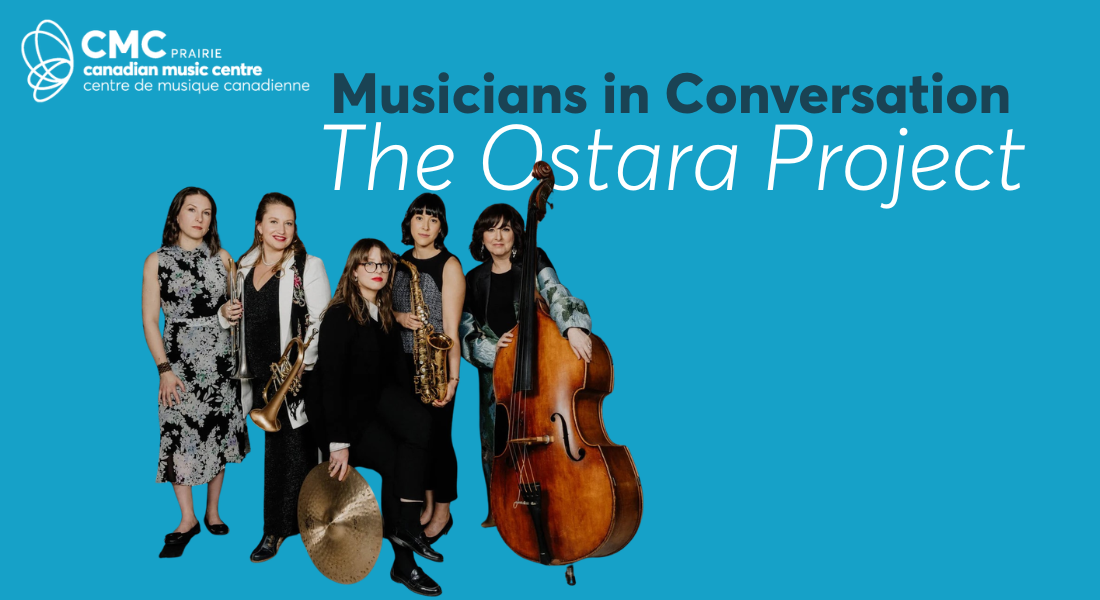
To celebrate International Woman’s Day, we’re revisiting when CMC Prairie Director Janna Sailor sat down with award-winning bassist Jodi Proznick and band manager Lisa Buck of the Canadian all-female jazz supergroup, the Ostara Project to discuss the release of their newest album Roots and their experience navigating the barriers faced by women in jazz.
The Ostara Project: Roots, Representation, and a High-Vibration Future for Jazz
Ostara—named for the Germanic goddess of the spring equinox—stands for renewal. It’s a collective of acclaimed Canadian women jazz artists whose work embodies hope, craft, and cultural breadth. With their latest album, Roots, the ensemble doubles down on what makes them singular: original compositions, fearless collaboration, and a clear-eyed commitment to equity in the jazz ecosystem.
How Ostara Began
Band manager Lisa Buck and bassist/composer Jodi Proznick first connected during COVID on a documentary idea about women in jazz. What started as a “mad experiment”—recording an album, filming a doc, and playing a sold-out concert in one weekend—proved electric. The resulting debut drew a Juno nomination and a wave of momentum.
“We wanted to create a lighthouse—music first—where everyone can see powerful, capable women unapologetically making beautiful music together.” — Jodi Proznick
With pianist and music director Amanda Tosoff at the helm, the founders chose an instrumental core to highlight a space where women are still underrepresented—then began inviting guest vocalists to expand the palette.
The Ensemble
Ostara brings together award-winning artists from across Canada, each a recognized bandleader and composer:
- Jodi Proznick – bassist, composer, educator, community builder
- Amanda Tosoff – pianist, composer, Juno-nominated bandleader
- Allison Au – saxophonist, multiple Juno winner
- Rachel Therrien – trumpeter, recent winner of Cuba’s “Grammy” equivalent
- Valerie Lacombe – drummer, composer (Montréal)

L-R: Amanda Tosoff, Rachel Therrien, Valerie Lacombe, Allison Au, Jodi Proznick
Janna Sailor: Well, first of all, huge congratulations on the latest album Roots! It’s truly so original and refreshing, and I found it truly moving. Can you tell us about the group and the concept of it?
Lisa Buck: Jodi has been the driving force behind Ostara, and our pianist Amanda Tolstoff, is the music director. I had been in contact with Jodi about a documentary that I wanted to make during COVID called “Change The Tune”. We looked at the challenges faced by female jazz, which came out of my work as artistic director with BuckingJam Palace, a jazz series that I program in Calgary. I just looked around and thought “where are all the women, and what’s up with this culture? It’s a little negative and bro-like”. So I phoned up Jodi, who was not surprised by my question, and so she helped me determine which women to include in the documentary.
Jodi Proznick: I’ve been in this profession for 30 years and have had arguably a very successful time in this ecosystem, despite some of the barriers that do exist. It was getting to a point where I felt I needed to not just rest on my successes and my experiences that were generally positive, because I was looking around at the ecosystem and seeing that there wasn’t a lot of change in terms of the numbers of women that were involved with this music. And to be quite honest, I love making music in a jazz context so much that I was just saddened by the fact that there weren’t more women getting to experience this incredible music and creating music with others.
So the project was really the brain-child of Amanda and I trying to figure out how to do something that was about the music first, but also a way of amplifying and creating kind of a lighthouse for not just other young women, women presenting, or non-binary people, but for everyone. Even for the young, young men in the ecosystem to see powerful, capable, competent, women unapologetically making really beautiful music together. And I think that is more of a change.
I think the conversations are great; this kind of truth and reconciliation with the music ecosystem is super important and allows space for stories of harm. But we decided that creating art together, standing on stage together, vibrating at a really high frequency, with a lot of competence and joy and community was our way of creating an alternative reality to how such a space might feel for people. So we just wanted to get out there and make some art, and luckily, Lisa had the same idea. My record label at the time, Seller Live had reached out and inquired about putting more women on the label, because there were so few. There was a weekend where we were able to do the documentary, make an album and sell out a concert here in Vancouver. It was such a positive experience that Amanda, Lisa and I decided to keep on going with it.
Janna Sailor: Recording an album, filming a documentary and perform at a sold out concert! All in a weekend’s work!
Jodi Proznick: The night we did the recording, we were just shocked at how great it was, given that we had just met that Thursday. It was a mad experiment, but everyone was so in on it, with this great energy of really wanting to deliver. The album went on to get nominated for a Juno, which is quite remarkable given that the majority of us were strangers to each other. That’s the thing though with music. People who are very skilled can go anywhere and create art together relatively quickly. It’s a pretty magical thing that I just want more people to be able to experience. It’s an affirming thing to do as a human. It’s medicinal in a way.
Highlighting the Talented Members of Ostara
Janna Sailor: I just wanted to touch on the fact that these are all incredibly talented, award-winning members, all female-identifying of Ostara that have gone on to win awards, and have acclaimed solo careers. Can you tell me a bit more about those members and how you went about drawing them all together to this wonderful project and what unifies you in this vision for Ostara?
Lisa Buck: I think that’s a really great question and, I think it’s worth noting that these women are drawn from across Canada. You can imagine the challenges of rehearsing and touring that come with all of that, but that’s what it really took to bring a center of highly competent women together. We wanted women that were composers and band leaders in their own right. They all have their own distinct voices and projects. And there’s a challenge where everyone has got their own thing. How do you come together and have a unified sound? And one of the things that’s been really gratifying to track, particularly with the second album, is I hear this unified sound coming together, which comes out of the relationships that have developed.
I get the privilege of listening to the concerts and being able to observe the recordings, and what’s really remarkable about this group of women is they’re so supportive of one another. When someone is on stage and taking a solo you can just feel them giving their love and energy to the performers, celebrating their colleagues and now, close friends. I think that’s something that anyone can offer, women don’t have that character alone, but I think we’ve been given more permission in society to offer that. And I see that as something that Ostara and other women are infusing the jazz world with.
I’m gonna talk about Jodi because she’ll be modest, but Jodi, I hope it’s fair to say you are a maven of the jazz world. She’s truly a lighthouse that people admire and respect for all sorts of great reasons. A long career in the arts, many leadership positions and a tremendous bass player Amanda Tolsoff is our pianist, a Juno nominee and a beautiful composer. Allison Au on saxophone has two Juno awards and many many more nominations. Rachel Therrien just won the Cuban equivalent of the Grammy, a beautiful trumpet player from Rimouski, Québec, spending time both in Montreal and Toronto. And then the wonderful drummer, Valerie Comb from Montreal. Lovely composer and a beautiful player.
We wanted Ostara to be an instrumental group to make the point that that’s usually where women don’t get roles. And then we invite guest vocalists, depending on the project or the album. The next album that’s coming out, it’s already in the can and it has multiple guest vocalists on it. Just to really give a platform to many Canadian voices, to many women, many heritages and both geographic and cultural identities.
Composing for the Collective
Janna Sailor: Something that you just touched on, but that I wanted to, zero in on, is something that makes the Ostara sound so original is that these arrangements and compositions are all created internally, specifically for this group. and I imagine there’s a lot of interactive process that goes on there. Can you talk about that a bit more? You have these extraordinary composers, that you mentioned, that are career composers within the group. But I understand everyone has a role to play in the creation of these tracks, right?
Lisa Buck: Yes and, Jodi’s the one that sets the context for that, that is just such a rich and welcoming environment. So, Jodi, I’m interested to hear what you have to say about that.
Jodi Proznick: Well, the jazz composition landscape is a really interesting one. I think the really great composers often do two things. One is they write really strong material that can stand on its own, but often we’re writing for a group of people. So as you’re writing, you’re sort of having the strengths or the sounds or the characters in mind as you’re creating for the group.We’ve all been at this a while now so we know how to find that fine line between your voice, and do it relatively quickly because we don’t have time to rehearse for hours. It has to be music that can kind of come off the page as quickly as possible without losing, the, voice or the, technique, or the compositional voice, of the people who are bringing the music in. As our relationship is developing as a band, I think we’re all writing for the group with even more understanding of who they are as people. So you know, it’s interesting. These songs have a pliability, but when we’re writing for a project, I definitely have the band in mind, and that’s a fun part of building art in community with others. So those interpersonal relationships off the bandstand end up embedded in the music and in the compositional style. I’m curious to see where it all goes. For the next album, we invited a bunch of Canadian women vocalists to bring their music in or we wrote for them, for specific voices. And so that was a little bit of a difference, where it wasn’t quite kind of the core five, rather it was people from outside, but it still worked. These women are some of the best musicians I know, like we happen to be women, but really they’re top-notch composers. It’s just a win-win all around, and it’s so much fun playing their music. And even though some of it is quite complex, you’re playing good material when there’s an intuitiveness as you’re sight reading or you’re making sense of it. You understand that this is where you wanna go right now because it’s just telling you. All the women write like that, so it’s a delight to play everybody’s music. It’s a real collective that way.
Keys to Collaborative Success
Janna Sailor: An ensemble like this is dependent upon a successful, respectful collaboration, which allows each voice to be heard. Can we talk a little bit more about what goes into such a successful and organic collaboration?
Lisa Buck: Just playing off of talking about the first album and this second one now, there’s a care and compassion that is in this group that I find quite profound. When Rachel Therrien brought her piece Papa to Whitehorse where the group was doing a residency in 2022, and it was just six weeks after Rachel’s father had died. He was a boat captain, and you can hear the lilt of the sea in that piece. It was a very emotional moment as we were workshopping pieces and Rachel had said “I have this piece and you know, my father has just died”. And, there were tears all around and, this lovely sharing and holding of both Rachel’s creativity, but also of her grief, and her celebration of her father. And when I hear that piece, even now as I talk about it, it makes me teary because it’s such a great example of art taking in all the profundity of human life and transforming it into something beautiful, that grief and celebration and memory all coming together. I think that is such a powerful aspect with Ostara, that these artists are sensitive, supportive, compassionate, kind, and a ton of fun.
And there has to be that professional respect where you know that, the quality is there of the person’s performance. You know, you can trust them, you know that they’re gonna bring good quality material to the album. But then there’s this lovely friendship that just bubbles up through all that professionalism.
Jodi Proznick: I think sometimes in the professional music world it can be a little bit disembodied, especially with instrumentalists where you can show up to rehearsal and you just sort of play the music through and you miss out that interpersonal energy. The reason I love playing jazz is that it’s social music. It’s a conversation, and there’s nothing like having great conversations with people, and that’s essentially what we’re doing on our instruments. So I think that we’ve managed to curate a core crew who are both great conversationalists on and off the band stand.
When I was on tour with saxophonist Phil Dwyer, he told me that “the key to this life, Jodi, is to curate it well, be mindful of synergy and how people will interact not just as musicians, but the community building aspect as a whole. I’ve taken that to heart and feel like this music project is like a big dinner table. Lisa’s one of the best hosts in the world, and exemplifies this when she opens up her home to musicians. And I like to try and do that in professional spaces where it’s pull up a chair, you’re safe immediately, and let’s see what kind of adventure we can have together. It’s this magical energy that people hear when they watch groups who genuinely care about each other. In addition to the expertise, there’s this love, the connection, the compassion, this wholeheartedness, and a generosity of spirit.
Lisa Buck: I love your description that you use, and it applies to all the women in Ostara, that they are strong in the back and soft in the front.
Jodi Proznick: For us, this is an even bigger story because it’s really important to me that we’re not just delivering excellent music, but also qualities of leadership in our ecosystem, offering an alternative to a world that has been very heavy on the expertise and sometimes turns a blind eye to issues with the humanity part. I think our music ecosystem is needing a renovation where we lean more towards not just technical expertise or an impressive resume, but also contributing to the ecosystem, the community, the heart, and the medicinal nature of music.
The bigger idea of this project is to just be high-vibration and offer a template for a different way of contributing to the music community.
Exploring Cultural Roots Through Music
Janna Sailor: In regards to this latest album, when you were formulating the seed of the idea and the concept of Roots, how did that unfold and take place? Did it follow the path that you thought it would, or were there some surprises and some side quests along the way?
Lisa Buck: Well, the invitation made to the artists was to help us represent the Canadian mosaic in many ways, which I find very timely right now. One of the things that all of us love about Canada is that the Canadian identity allows for ethnic identities of places where we’ve come from, and we don’t need to shed that in order to have a Canadian identity – rather it’s integral that we carry those traditions along. This formed the invitation and this central idea of Roots, of where we come from. I think it’s interesting how people responded to that, Rachel’s piece reflects her roots in Rimouski and her father. Jodi’s piece reflects her roots in Ukraine, and her family going back several generations. Amanda explores the reconnecting of her Bulgarian roots, and Allison’s piece reflects her Jewish grandfather’s experience and the tattoo that was put on him in Auschwitz. So everybody interpreted what part of their root they wanted to express or discover. It was so fun to lay out the theme,see how people chose to express within that, and I think it created a rich result.
Jodi Proznick: I would say I’d rather than have a dictation, it was more of a primary question, you know, “what does your roots mean to you?” And just like Amanda, my family is Ukrainian on my dad’s side. I have never been to Ukraine, but I had a visceral reaction when the war broke out. Just as I think a lot of people in the diaspora from different regions feel a connection to a place that they may have never been. And why is that? For me it was through the arts, through the music, through the language, and the cultural traditions that were passed on. It got me really thinking about how important the arts are, not as a dictation, but rather an invitation to our humanity and to the artistry. The art piece is that, we all are this assimilation of many different stories and many different colors, textures, sounds, tastes, and getting back to those roots of “What does it mean to be?” and this visceralness that music can do like nothing else, in my opinion.
So the songs are little different chapters, different pieces of poetry. I like to equate it to an art gallery where each song is a piece of art that an artist has brought forward, and our job is to curate the room, the gallery with all of the connective themes, with all of the different perspectives. We can all share these stories with each other and be generous in spirit, So right now, when there’s so much opposition, othering and separation, we all sit and tell our stories with each other and have a laugh, and then go play songs.
Janna Sailor: I just wanted to touch on one additional layer that is unique to this album, which is the addition of the Hindustani vocalist. Shruti Ramani, who is absolutely extraordinary. It was amazing how their contribution fit in so beautifully to every single one of these tracks, and how she just flowed with the music, just like water. Can you tell me about that collaboration and how that came to be?
Lisa Buck: Shruti is a remarkable musician and trained in the classical Indian style, which took eight years for the initial education, and she’s a great example of what Jodi was talking about earlier of someone who has tremendous technique. In the arts, you have to have a level of expertise, but she transcends that, infusing that tradition that she has such a great handle on with jazz and bringing really a whole new creative spirit to both Ostara and her own project, Ragaverse, which was nominated for a Juno this past year, and Jodi’s the bassist of.
Jodi Proznick: What’s interesting is that this is all a product of the pandemic. When everything just stopped, all of these projects, all of these ideas, it was like we had a moment to just take a breath and all of this really interesting stuff came forward, and Shruti was one of those people. She’d moved to Vancouver from Mumbai, and gone to school at Vancouver Island University. I found her on social media during the pandemic, reached out and connected with her. Then she just asked if I would play a gig with her. We did this little gig at a restaurant in Vancouver. And you know those stories of when someone discovers someone in a bar singing some music and they become a big star? I sort-of took her under my wing as a veteran on the scene, and gave her support. Now she has management and I actually started a record label because of her. It’s a wonderful group and I just am excited to see where she goes. And to me, she’s the future. She’s queer, Hindustani, and jazz-trained, living in Canada as an immigrant. The community just was like, yep, we love you. And so Vancouver’s been very supportive when we decided to have more of a frontline vocalist. A situation that had a little more pliability, so we were able to invite more voices in. She just seemed kind of like an obvious choice. I love the idea of these different women, different voices, different perspectives, landing on stage, sometimes singing together and it’s just awesome.
Addressing the Barriers Faced by Women in Jazz
Janna Sailor: We touched on it right off the top when we were talking about Ostara’s role in the ecosystem. But let’s talk about what is perhaps the elephant in the room, which is female representation and leadership in the jazz scene. Both of you are very active advocates for equity and supporting women and the jazz scene in your various spheres, can we dive into your approach and your thoughts on that, and where we are historically in, context with the inclusion of women in jazz?
Lisa Buck: This is a timely topic for me. I just came back two days ago from Helsinki and Copenhagen. I have an association with JazzDenmark who are the global leader in something called JazzCamp for Girls. Their initiative started in 2015, when they did a survey and found that in their music industry, across different genres, women represented about 30% of the population. However in jazz, it’s significantly less than that. Estimates are that in North America, 5% of the professional instrumentalists in jazz are female-identifying, which is egregious. And it tells you that there’s something, other than lack of interest going on there, that’s creating a barrier. I think it’s a lovely thought that we could just let people be artists together and eventually there’d be an evolution towards equity. But the truth is, if the gatekeepers are all male and in jazz, people tend to play with their buddies, and hang with their buddies. It’s not always a conscious attempt to keep women out of those spheres of influence and creativity, but it’s the default for men to hang out with other men. At some point you have to insert yourself into that system pretty strongly.
I have an 18 month old grandson, and I was reading him a little sound book, where you push the button and it plays a song, with six tunes total. There’s a little band with little people playing. And with all the discussion of Canadian sovereignty and culture happening, I was looking at the book with slightly different eyes and I thought, “Oh, all these songs are from the American songbook. I guess I can give that a pass. However, it would be nice if we had some of our amazing Canadian musicians represented”. And then I looked at this book again, which I probably read 20 times at this point, and I thought, oh, and all of the musicians are male. Even the little cat, who’s the mascot in every picture, he’s a male. And so I thought, wow I can’t believe I didn’t see that before, but we don’t, because that’s the default. So I quickly ordered the other two sound books that I could find, so that I could examine them.
Same thing.
Of these three books, there were 55 musicians represented that were male. There were two women that were musicians. One was a singer in that classic, sexy,1950s torch-light song style.
Janna Sailor: Almost a caricature.
<span styl