
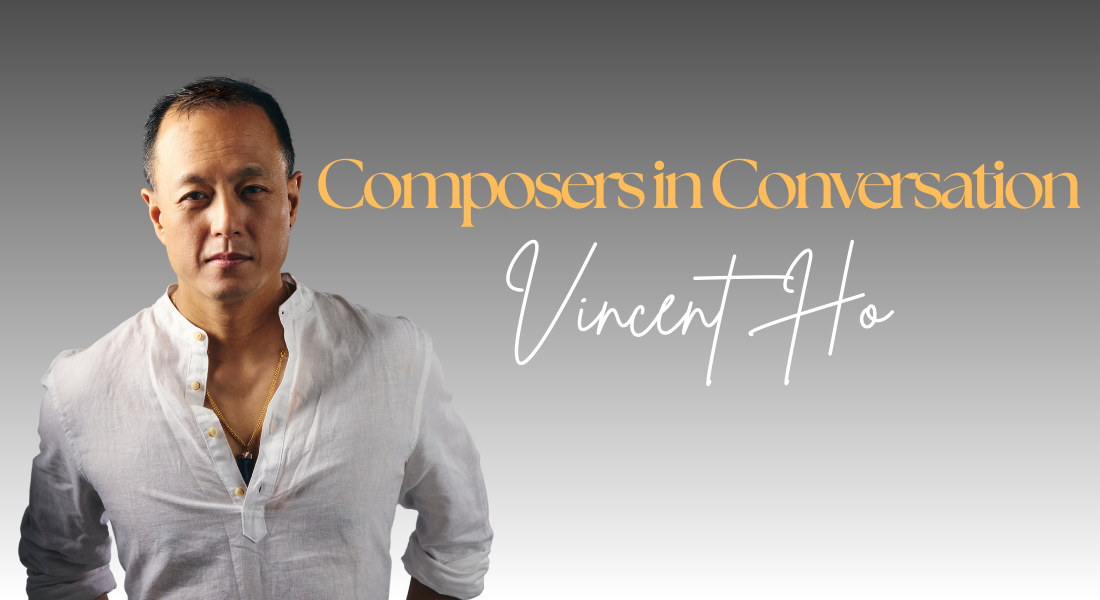
To celebrate his 50th birthday and recent premieres and performances with orchestras across Canada, we’re looking back at Vincent Ho’s conversation with CMC Prairie Region Director Janna Sailor on MUSING!
“What keeps me going the people who inspire me and the people who I want to write for because there’s something about their talents that I want to honor in musical form.”
– Vincent Ho
Janna Sailor: For folks that are maybe just discovering you and your music, how would you describe your musical approach and output?
Vincent Ho: It depends on the day that you ask me, and also at what time of my life. These days I’m a composer full-time and I work at home. My general process is dependent on so many factors; what I’m inspired by, what the project is, and who I’m writing for. In fact, who I’m writing for plays an incredibly important factor on how I write my music. It’s much like how a playwright writes a play depending on who they have as a cast. If I was a playwright and suddenly one day Denzel Washington, or Meryl Streep calls me and wants to work with me, then of course that’s going to determine the kind of role I’m going to write for them. This is the same approach. If I get contacted by an ensemble, orchestra, or soloist that wants to work with me, I try to gauge whether it’s a good fit. I also try to see if the soloist or ensemble has the kind of talents that I feel would generate an inspired composition. I’m very fortunate to get requests from many artists that I truly admire and respect.
Looking at my catalog, many of the pieces I’ve written are inspired by those artists; Dame Evelyn Glennie (percussionist), Timothy McAllister (saxophonist), Vicky Chow (pianist), Land’s End Ensemble, and so many more. I’ve developed such long-term collaborative relationships where it yields many projects. Once we finish a project, we evaluate whether it was a good process, if we’re happy with the results, then shape our collaborative relationship that will dictate the future of our projects together.
Influences on Vincent’s Career
Janna Sailor: Looking back at your career, do you see distinct stage in your output or musical voice? Have they been influenced by some of these collaborations?
Vincent Ho: Oh, absolutely! I was very fortunate to be given so many opportunities to allow my process to continue, grow, and to shape my musical language.
The first significant relationship I had was with the Winnipeg Symphony Orchestra (WSO) when I was appointed composer-in-residence back in 2007. It was a very rewarding period just to be able to write for the orchestra, to collaborate with the musicians, and be given the opportunity to pursue [my own] projects. Some of my most meaningful projects that I created with the WSO are: the Arctic Symphony where I was given the opportunity to visit the Arctic and write my symphonic response to that, my first percussion concerto for Dame Evelyn Glennie, a cello concerto for Shauna Rolston, and many others. That was the first significant impact on my growth as a composer. When someone asks me about the stages of a career, I usually joke that in the arts there’s three stages: emerging composer, established composer, and then forgotten composer. So, that’s the running joke. When my period with the WSO was done, I moved back to Calgary and I think that I’m starting to be in that established period.
I continued my track record with other colleagues who I’ve met along the way throughout my career up to that point and that has continued for the last 10 years. Now that I’ve reached 50, the joke of being a forgotten composer was in the back of my mind. But to be honest, I don’t see any slowing down, which is quite a delight. I’m very grateful because it is so hard to pursue a career as a freelance composer; to sustain a career as a composer, and to continue that energy even into your senior years. I don’t consider myself senior, but at 50, you can’t help but start to think about what the next 10 years has in store for you. To my delight, I’m still busier than ever.
I’m just finishing up a timpani concerto for the Taipei Chinese Orchestra. I’m writing a tuba concerto for Tom McCaslin for tuba and wind ensemble. I’m also in preparation of a new piano collection called the 12 Chinese Zodiac Animals: Book Three Concert Etudes, which is going to be premiered in New York by students of the Manhattan School of Music. So, it doesn’t seem like there’s any slowing down, which I’m so grateful of. I am inspired every morning to start writing music for people who inspire me, and I hope to continue this energy for as long as I can.
Janna Sailor: Tell me about those sources of inspiration and what gives you that energy.
Vincent Ho: For a composer or any artist trying to write something from a blank slate, it’s hard enough. That’s why I rely on collaborators who I trust because they inspire the best out of me. For example, Vicky Chow and Ben Reimer premiered a work of mine for a drum kit and piano called Kickin’ It in Vancouver. It was just a wonderful collaborative process, and we were just jelling creatively. She and Ben were so inspiring, Kickin’ It 2.0, the version with piano trio and drum kit, was nominated for a JUNO AWARD. So, my process of writing with Vicky and Ben inspired the best out of me that yielded a strong piece that we’re proud of. Several years later, I said to Vicky, “you know what? I would love to work with you again. Let’s see what, ideas come up”. So, through our collaborative conversations, we came up with the idea of writing a collection of piano etudes inspired by villains of the Batman universe. And I thought “yeah, that’s exciting”. That just taps into so many things that I want to explore in musical form, especially in pianistic form. So that collection [Supervillan Études], has now become my most performed collection, and was also nominated for a JUNO AWARD two years ago. When I write a piece, I don’t start until I know what the inspiration is, who I’m writing for, and what we inspire out of each other.
Another example is this tuba concerto. I didn’t know what the inspiration was going to be, but I know that Tom is someone that I truly respect. He’s a fantastic tubist, and is the principal tubist of the Calgary Phil (CPO). After some conversations, things started to gel and I just couldn’t help but think of the comic book character King Pin because he just reminded me of that character. That started off my inspiration so that’s what I ran with, and the creative energy that he brought to the table. What keeps me going the people who inspire me and the people who I want to write for because there’s something about their talents that I want to honor in musical form. Another example is the timpani concerto for the Taipei Chinese Orchestra. When I first saw their timpanist, Hsin Fang, I thought “she’s just a rather small person”, but when she’s behind the timpani, she’s an absolute beast who can do almost anything on the timpani! We got into conversation about wanting to write a piece for her, and I got this energy from her, this like firecracker energy that conjured up so many ideas. I couldn’t help but think that given this generation she’s from and the kind of energy she brings to the table, I couldn’t help but think of rave culture. So, this timpani concerto is titled Cyber Rave. It’s inspired by that, but written in the context of Chinese traditional instruments. What excited me was seeing what I could come up with that would bring together the rave culture together with this traditional world.
Turning Points in Vincent’s Career
Janna Sailor: Talk to me about maybe some significant turning points or milestones in your career.
 Vincent Ho: There’s several that stand out. Firstly, definitely the Arctic Symphony because I’ve never written a symphony. Up until that point it was just little orchestra works, but a full–on symphony was a tall order. I felt I really needed to up my game and pour my heart into that project because I wanted to create a symphonic portrait of the Arctic as I experienced it. That was an incredible process; going to the Arctic, visiting the indigenous communities, meeting with the scientists and learning about the Arctic from both sides of the world, and trying to take all that in and express it in musical form. That was a profound impact as an artist, to be bringing together the scientific world and the traditional world, together in symphonic form. The other was my percussion concerto, The Shaman, written for Dame Evelyn Glennie. Up until that point, I had never written anything for a musician of that caliber. By that point she already had legendary status, and so I was scared to death. I mean, why on earth would she wanted me to write a piece for her. I went through a very, very arduous process in preparation. I spent three months just practicing on the piano to try and raise my musical skills as close as I possibly can to her level if. I’m going to write a piece for her, I have to be sure that we spoke the same language in terms of musical abilities, or at least as close to as possible to be able to write something that honors her abilities. I spent like three months, about three to six hours a day practicing the piano. I had a diet of composers that I chose for specific reasons: the late Beethoven for the emotional content, Prokofiev for the rhythmic vitality, Ligeti for technical virtuosity, and Ravel for sonic colors. After those three months, I felt I was in peak form and was ready to write the piece. I poured my heart into writing that piece, and she premiered it with the WSO on the opening night of their 25th anniversary; it was broadcast nationwide. That was one of the most significant events of my career to write something for a musician of that caliber on that scale, and it was something that we are both very proud of.
Janna Sailor: People might not be familiar with her and her work, can you tell me more about working with Dame Evelyn Glennie, an artist who is deaf?
Vincent Ho: Yeah. She is one of the greatest artists I’ve ever had the pleasure to work with and continue to collaborate with. She heard my Artic Symphony and when we invited her to the Winnipeg New Music Festival (WNMF), she wanted me to write a piece for her. That said a lot. I mean, she’s a percussionist who’s deaf, but was able to overcome that by approaching percussion differently than most Western classical artists. What I mean by that is that she experiences music very differently. She doesn’t experience music within the criteria of melody, harmony, rhythm, or counterpoint; she experiences music as beyond that from the vibrations of sound, the sonic colors, and more importantly the energy that every sound and performer expresses when she’s in performance. She responds to that through her entire body. In fact, she even says that her entire body is an ear; she doesn’t just rely on just one factor, it’s everything surrounding it. Even when I see her testing instruments to see they are up to her standard. I can see that she’s not just testing the sound. For example, playing on a tom-tom, she’s tapping on every area trying to develop a connection with it, or trying to draw out the “soul” of that instrument to see if there’s something there that she can work with. She’s trying to draw out what kind of energy each instrument has. So, it’s not just the sound, but the possibilities of what that instrument is capable of. That will draw out her response to that energy within those instruments and inspire her to perform accordingly to what the possibilities of that instrument is. It was inspiring to me to see how she approached that. The first time I worked with her was intimidating, but the more I worked with her, the more I understood the world she came from. I came in from the world of the Western musical tradition, and so I had to quickly abandon all that and adopt her world. Experiencing music through her world, experiencing every sound, every gesture, every sonic color as she experiences it and try to find a way to communicate with her in my music that, fits within that criteria, I guess you could say. Or just how she connects with the world so that it better allows her to express who she is as a percussionist. Another creative impact for me from working with her is to put myself in the performer’s shoes to understand what their strengths are, their limitations are, and gives me something to work with to see what I can work with in that, and see how far I can push those boundaries in the music I write for them.
The collaborative process is fantastic. I mean, we have a very healthy dialogue. She tells me if something works or something doesn’t work or something that she has an idea that I can improve on. It’s that kind of relationship that I treasure because it makes me a better composer. It makes me better understand her performance practice, the percussion performance practice, and it really impacted how I write music from then on with everything I learned from her.
Janna Sailor: Beautiful. And I love how you spoke about building and establishing that trust and that relationship.
Vincent’s Creativity and Inspiration
Janna Sailor: I wanted to touch on something that I personally really love about your work. There’s so many programmatic elements and you derive subject matter from everything from super villains, comic books, and movies to the world around you in the instance of The Shaman and the Arctic Symphony. What kinds of elements do you try to embody and capture in your music?
Vincent Ho: That’s a great question. You know the saying “always listen to your inner child”? The other part of that that I add is “be sure to guide it with your outer adult”. That’s the approach that I take with every piece or every process. I try to still maintain that childlike sense of wonder and enthusiasm; I don’t want to get jaded by the realities of the professional world. I still want to retain that fascination and curiosity that I once had when I started out composing, or even when I started out as a child playing with Lego. Now, with the outer adult, that’s where experience and technique come in. I come up with ideas that I’m inspired by, and then I try to find a way to communicate it to audiences and musicians in notation form that would be very clear as to what the music is trying to say. It’s how many creative artists write. And so, when it comes to many of my works, yes, there’s a lot of extra musical inspirations.
The super villains is a great example. Several years ago, one summer I found my collection of Batman comics and it was also during a time when I wanted to write some my own set of piano etudes, but I didn’t have a theme for it. As I was rereading these comics, I realized that many of the Batman villains are put in Arkham Asylum, which is not a prison. That suggests that they have neurological or mental disorders that are manifested in criminal form. That got me thinking “what if I did a psychological profile on them”? And that’s what I did. Riddler, Two-Face, Penguin, Catwoman, Poison Ivy, and of course Joker. It was fascinating just to treat these characters as actual human beings with case studies. Once I had their psychological profiles, then I gave it to three dancers and choreographers and asked them: “if these were real people and you read their profiles, how would you recreate their movements? How would they walk? How would they move their hands when they talk”? And I filmed them and I found their interpretation’s fascinating. That triggered a lot of ideas for me to recreate them in pianistic form. This is one of those examples where it started with the comic books.
So, the inner child in me was said “oh, wow, my comic books, I love this”, and the outer adult comes in and started to approach it with a process of creating the psychological profiles in very detailed form. This all came from speaking to dancers and choreographers and then figuring out how to recreate those in pianistic form. And so that’s how the imagination or the musical universe I create is created.
Collaborations with Orchestras
Janna Sailor: Brilliant. I love that multifaceted approach with those attitudes. You have some really amazing projects coming up, can you expand a little bit more on the concert with Dame Evelyn Glenny and the Saskatoon Symphony Orchestra (SSO)?
 Vincent Ho: The SSO programmed my second percussion concerto I wrote for Evelyn Glennie. It’s called From Darkness to Light: A Spiritual Journey. It was a premiered in 2013, by the WSO. After the success of The Shaman. Evelyn and I were very eager to work together again, we just didn’t know on what capacity and I really wanted to write another concerto, but I needed to find an inspiration. I didn’t have one yet.
Around 2011 or 2012, I got contacted by a friend from Los Angeles, Luc Leestemacher, he’s a wonderful artist and an entrepreneur, and I was informed that he was diagnosed with cancer; he was detailing the year that he had to live with cancer from being diagnosed, going through the treatments, his spiritual journey, and then eventually coming to that point that one comes to, which is acceptance. He and I were very close, and he was a big supporter of my music. During that year, he also created a lot of paintings to track his journey, to express his journey in artistic form. And he found that [process] so therapeutic and a beautiful way for him to share his journey with others who are living cancer as well as a way of connecting with them.
So, he proposed the idea of creating a symphonic work that expresses that journey, hence the title From Darkness to Light. And it was a pretty heavy topic. I talked to Dame Evelyn and we agreed that this was a theme that warranted symphonic representation. Up until that point, I didn’t have many people within my friend group that was impacted by cancer; I didn’t have anybody I knew closely until Luc was diagnosed. And so, I felt I needed to really dig into the topic. To prepare for that, I interviewed many people who were either living with cancer or had survived cancer. Listening to their stories, I realized that they all shared similar journeys across the board, Luc included. That had a profound impact on me. I also collaborated with the University of Manitoba’s Oncology Department to try and understand all forms of cancer and the research around it. That set the stage for me to write my symphonic response to cancer and try to give voice to those who are living with cancer, so that they may share their journey with others in symphonic form. The performance in Saskatoon is going to be very meaningful because the last time I had a performance there was the premier of my saxophone concerto, Whimsical Concerto of Fanciful Birds that was premiered by the SSO with Timothy McAlister as a soloist and conductor Robert Franz in 2023. As of two months ago, Robert lost his battle to cancer. So, coming back to Saskatoon and knowing that the last time I was there I worked with Robert and with his battle with cancer tied with what this piece is about, it’s taken on a very significant meaning.
Those know my music and who were initially involved in the process of the creation of the piece back in 2013 are coming to Saskatoon. They are coming in from Winnipeg, Los Angeles, and Calgary to attend this performance because, over the years, the piece has taken on a very significant meaning for many of them. This is one of those orchestral works that taps into an area that affects everybody on some level.
Janna Sailor: And speaking of Maestro Franz, you mentioned the Windsor Symphony as a collaborator on an upcoming project.
Vincent Ho: Yeah. After Robert premiered my Saxophone concerto with Saskatoon, he immediately programmed it for this season with the Windsor Symphony, and he was planning on conducting it himself, with Timothy coming from Michigan to perform as a soloist, as well as bringing six students from the University of Michigan saxophone department to perform the spatialized saxophone part. When Robert premiered it, it was a wonderful performance, we couldn’t be happier, and he was very excited to bring it to Windsor. Unfortunately, with his passing, they had to bring in another conductor. Both Timothy and I are going to be very emotional during the performance, knowing that this was Robert’s orchestra. He was the music director of the Windsor Symphony for many years, a huge advocate of contemporary music, and made a significant impact in the community in so many ways. To perform the work with his orchestra knowing that he’s not there, it’s going to be very emotional.
Vincent’s Latest Album
Janna Sailor: You have an amazing new album out as a result of a collaboration with pianist Tony Yike Yang, can you tell us about that?
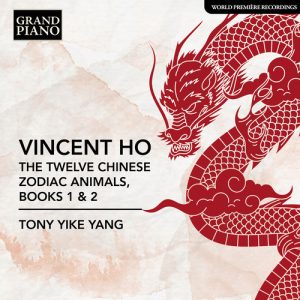 Vincent Ho: Yeah. the album features my two piano collections, the Twelve Chinese Zodiac Animals: Book 1 & Book 2: Preludes and Fugues. I was inspired to write a collection of piano pieces for my daughter that were little portraits of each zodiac animal. I started with her [zodiac animal], which was Dragon. The process was enjoyable and so I wrote the remaining pieces for the remaining 11 animals. When I submitted it to the Royal Conservatory of Music, they selected 10 of the pieces to be included in their piano repertoire, which is phenomenal; the pieces have really taken off. That inspired me to write Book 2, a collection of Preludes and Fugues that depicts the animals in their teenage years. These were premiered here in 2023 during Lunar New Year by 12 of the students from the University of Calgary’s piano department. At that time, I was introduced to Tony Yike Yang. He gave a wonderful performance at the Royal Conservatory, when they were released the brand new piano series. I was invited to talk about my pieces there, and that’s where I met him. I just felt that he was the right fit. He’s so talented! He’s so easy to work with and as a product of Chinese culture, he knows about the Chinese zodiac animals. We started talking and he’s like, “yeah, I would love to record these pieces”. So, that’s how it all started and we’re very happy that the album is now getting its release this November 7th through Grand Piano Records.
Janna Sailor: Brilliant. Congratulations.
Vincent Ho: Thank you so much.
ABOUT VINCENT HO
Vincent Ho is a multi-award winning composer of orchestral, chamber, vocal, and theatre music. His works have been described as “brilliant and compelling” by The New York Times and hailed for their profound expressiveness and textural beauty, leaving audiences talking about them with great enthusiasm. His many awards and recognitions have included four Juno Award nominations, Harvard University’s Fromm Music Commission, The Canada Council for the Arts’ “Robert Fleming Prize”, ASCAP’s “Morton Gould Young Composer Award”, four SOCAN Young Composers Awards, and CBC Radio’s Audience Choice Award (2009 Young Composers’ Competition).
During the period of 2007-2014, Dr. Ho has served as the Winnipeg Symphony Orchestra’s composer-in-residence and had presented a number of large-scale works that have generated much excitement and critical praise. His Arctic Symphony has been described “as a beautiful work that evokes the Far North in a very special way” (John Corigliano), and “a mature and atmospheric work that firmly establishes Ho among North American composers of note” (Winnipeg Free Press). His percussion concerto, titled The Shaman, composed for Dame Evelyn Glennie was hailed as a triumph, receiving unanimous acclaim and declared by critics as “Spectacular” (The New York Classical Review), “A powerhouse work” (The Winnipeg Free Press), and “Rocking/mesmerizing…downright gorgeous” (The Pittsburgh Gazette). His second concerto for Glennie titled From Darkness To Light, Ho’s musical response to the cancer illness, was lauded as “a lasting masterpiece of sensitivity and perception” (Winnipeg Free Press). His cello concerto, City Suite, composed for Canadian cellist Shauna Rolston, has received similar praise with critics calling it “Thrilling” (Windsor Star) and “Overflowing with striking ideas…The most successful piece heard at this year’s Festival” (Classical Voice America).
Born in Ottawa, Ontario in 1975, Vincent Ho began his musical training through Canada’s Royal Conservatory of Music where he earned his Associate Diploma in Piano Performance. He gained his Bachelor of Music from the University of Calgary, his Master of Music from the University of Toronto, and his Doctor of Musical Arts from the University of Southern California. His mentors have included Allan Bell, David Eagle, Christos Hatzis, Walter Buczynski, and Stephen Hartke. In 1997, he was awarded a scholarship to attend the Schola Cantorum Summer Composition Program in Paris, where he received further training in analysis, composition, counterpoint, and harmony, supervised by David Diamond, Philip Lasser, and Narcis Bonet.
In his free time, he enjoys running, reading, traveling, dancing, hiking, playing chess, and learning the keyboard works of Bach, Beethoven, Ravel, and Ligeti (among many others). He is also an enthusiast of old-time radio shows, photography, crime noir, Zen art, jazz, Jimi Hendrix, graphic novels, and Stanley Kubrick films.
Dr. Ho has taught at the University of Calgary and currently serves as Artistic Director to Land’s End Ensemble. His works are published and managed by Promethean Editions Ltd and Theodore Presser Company.